Guides
How to Write a Machine Shop Equipment List Buyers Trust
A machine shop equipment list buyers trust names every machine by type, make, model and quantity, then gives the numbers an engineer screens on: axes, travels, spindle speed and taper, bar capacity, and tool or pallet capacity. Group it by process, put your inspection equipment on the same page, and publish it as real text in a table, not a scanned PDF or a photo of a spreadsheet. State the tolerances you hold on parts routinely, not the accuracy figure from the machine brochure. Then keep it current, because an engineer who spots a machine you sold two years ago stops trusting everything else on the page.
Why do sourcing engineers open the equipment list first?
A sourcing engineer with a drawing on the desk is trying to rule shops out quickly, and a machine list lets them. If the part is 30 inches long and your largest mill travels 20 inches in X, they know in five seconds. If the part is a small turned pin in 303 stainless and you list a Swiss lathe, you stay on the short list.
It is also hard to fake. Anyone can write "precision CNC machining," but few shops will publish a make, model and count they cannot back up on a plant visit. Your capabilities page tells the story of what you make and for whom. The equipment list is the evidence underneath it.
What should each machine entry include?
Give every machine the same set of fields so a reader can compare rows at a glance. For most CNC equipment that means:
- Machine type. Vertical or horizontal machining center, 5-axis machining center, CNC lathe, Swiss-type lathe, wire EDM, grinder, press brake.
- Make and model. Spell the model exactly as the builder does. Engineers often know what a given model can do from the name alone.
- Number of axes. Say "3-axis with 4th-axis rotary" or "5-axis simultaneous" rather than just "multi-axis." For lathes, note live tooling, Y-axis and sub-spindle.
- Travels or work envelope. X, Y and Z travels for mills. Swing and maximum turning length for lathes. Table size and table load where they limit what you can fixture.
- Spindle speed and taper. Maximum rpm and the taper, such as CAT40, BT30 or CAT50.
- Bar capacity for bar-fed lathes and Swiss machines, in inches and millimeters.
- Pallets and tool changer where they matter: number of pallets, pallet size, and tool pocket count.
- Quantity. Three identical lathes is a different story from one, especially for production quantities.
Here is what a few rows look like in practice. The figures below are illustrative, not the specs of any particular machine:
| Type | Make and model | Axes | Travels or capacity | Spindle | Other | Qty |
|---|---|---|---|---|---|---|
| Vertical machining center | Make, model | 3 + 4th-axis rotary | 40 x 20 x 25 in | 12,000 rpm, CAT40 | 30-tool changer | 2 |
| Horizontal machining center | Make, model | 4 | 28 x 28 x 30 in | 12,000 rpm, CAT40 | 2 pallets, 20 x 20 in; 60 tools | 1 |
| Swiss-type lathe | Make, model | 7 | 1.25 in (32 mm) bar | 8,000 rpm | Live tooling, sub-spindle | 3 |
Travels and work envelope are not the same as maximum part size
Travels are how far each axis can move. The work envelope is the space the machine can actually cut in. Neither is the largest part you can make, because fixtures, tool length and a rotary all eat into the space. If you know your practical limit, add a line such as "largest part run to date: 34 x 16 x 8 in." Engineers read that as real experience.
Spindle taper tells the reader about rigidity and tooling
CAT tooling follows ASME B5.50, whose full title is "7/24 Taper Tool to Spindle Connection for Automatic Tool Change." BT is a related steep-taper design with a different flange, so the letters matter as much as the number. The number is the size. A 30-taper machine is typically a compact, fast drill-tap or light milling machine, a 40-taper is the general-purpose workhorse, and a 50-taper is built for heavy cuts. Listing "BT30, 20,000 rpm" next to "CAT50, 6,000 rpm" tells an engineer which machine suits small aluminum work and which suits heavy steel.
Bar capacity for lathes and Swiss machines
For bar work, bar capacity is often the first screen. Swiss-type lathes support the bar in a guide bushing close to the cut while a sliding headstock feeds it, which is why they suit long, slender parts. Give the maximum bar diameter in both inches and millimeters, since buyers and machine builders use both. For conventional lathes, give bar capacity alongside chuck size and swing.
How should you group the equipment list?
Group by process, in the order a buyer thinks about the part. A typical job shop list runs:
- Milling: verticals, horizontals, then 5-axis.
- Turning: CNC lathes, with live tooling and sub-spindle noted.
- Swiss: its own group, because buyers searching for Swiss work want to see it immediately.
- EDM: wire and sinker, with wire diameter range and maximum workpiece size for wire.
- Grinding: surface, cylindrical, centerless.
- Fabrication: saws, press brakes, lasers, welding equipment.
- Inspection: the last group, covered next.
List the most capable machine first in each group, under a plain heading such as "CNC turning equipment" that a buyer can scan and a search engine can match.
Why does inspection equipment belong on the same page?
A buyer wants to know you can cut the part and that you can prove it is right. Inspection equipment beside production equipment answers both in one visit.
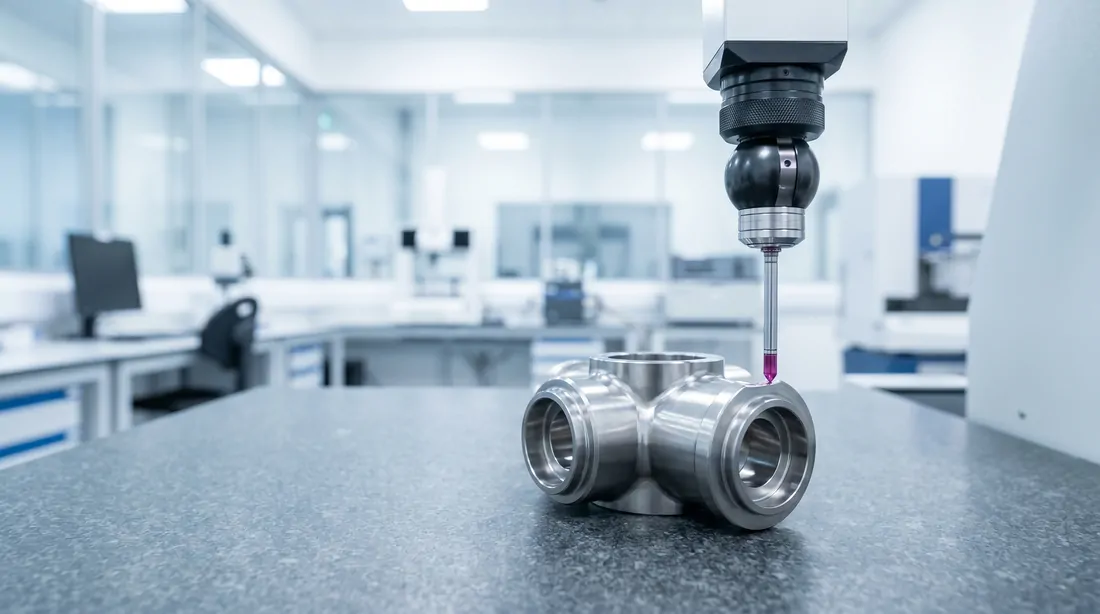
- Coordinate measuring machine (CMM). Give make, model, measuring range in X, Y and Z, the probe type, and the software you use for reports.
- Optical comparator or vision system. Screen size and magnifications for a comparator, or measuring range for a vision system. These matter for profiles, small features and soft parts.
- Surface plates. Size and grade. Plate makers describe three grades: AA (laboratory), A (inspection) and B (toolroom), made to Federal Specification GGG-P-463c and ASME B89.3.7. "Grade A granite plate, 36 x 48 in" is a real fact. "Precision surface plate" is not.
- Gauges and hand tools. Height gauges, bore gauges, pin gauge sets, thread gauges, micrometers, surface roughness testers. A summary line is fine.
Add one sentence on calibration. ISO 9001's measurement traceability requirement says measuring equipment is to be "calibrated or verified, or both, at specified intervals, or prior to use, against measurement standards traceable to international or national measurement standards." If you calibrate on a schedule, say so plainly. If you hold ISO 9001, AS9100 or similar registrations, list them near this section too.
Should the equipment list be a PDF, a photo or a web page?
A web page with a real HTML table. Many shops upload a scanned list or a photo of a spreadsheet. It looks finished, but it is the hardest version for people and software to use.
- Search engines. Google's Search Central blog explains that if text in a PDF is embedded as images, "we may process the images with OCR algorithms to extract the text," and that "if you can copy and paste the text from a PDF document into a standard text document, we should be able to index that text." "May" is not a promise. A scanned table also loses its rows and columns, so "CAT40" can end up detached from the machine it belongs to.
- AI assistants. ChatGPT, Perplexity, Claude and Google's AI answers quote pages they can read as text. A clean table row such as "Wire EDM, 2 machines, 23 x 15 x 12 in" is easy to extract and cite. A photo of the same row is not.
- Buyers on phones. The W3C accessibility guideline on images of text says "People cannot alter how text looks in images." A text table can be zoomed, searched with Find on page, and copied into a supplier spreadsheet.
Keep a PDF for trade shows if you like, but make the web page the master copy and generate the PDF from it.
How should you state tolerances on an equipment list?
State what you hold routinely on production parts, not what the machine builder publishes. Brochures quote positioning accuracy and repeatability, which are measured one axis at a time, not on a cut part. ISO 230-2, the test code behind many of those figures, describes its methods as "direct measurement of individual axes on the machine." A finished part depends on much more: fixturing, tool wear, material, temperature, the number of setups, and how you inspect it.
A practical way to write it, by group:
- "Milling: plus or minus 0.001 in routine, plus or minus 0.0005 in on selected features."
- "Grinding: plus or minus 0.0002 in on ground diameters."
Use your own numbers, the ones your inspection records support. The same goes for sizes: round travels down, not up, and never list a capacity you have not run. A buyer whose first order arrives at the stated tolerance believes the rest of the page.
How do you keep the equipment list current?
A stale list is worse than a short one. A few habits keep it honest:
- Put a date on it. A line reading "Equipment list updated" plus the month and year tells a buyer the page is maintained.
- Tie updates to real events. When a machine is commissioned, add it. When one is sold or scrapped, remove it the same week.
- Review it each quarter. Compare the list against the floor and against your capability pages so the numbers match everywhere.
How does the equipment list connect to capability pages and the RFQ form?
Treat the equipment list as a hub. Each process page shows its own machine group and links to the full list, and each group on the full list links back to its process page, so an engineer entering from either side finds both specs and context.
Then make the next step obvious. Put a request-for-quote button beside the list and after each process group, not only in the header. The RFQ form should ask for what the list just helped the buyer check: material, quantity, critical tolerances, and a drawing or CAD upload.
An equipment list is one of the cheapest pages on a shop site to build well, and one of the first a serious buyer opens. For the rest of the path from page view to quote, read how to get more RFQs from your manufacturing website, or see our page on CNC machine shop website design. Exhibit Domain plans are $99, $199 and $499 a month billed annually. Monthly-only billing costs 25 percent more and cancels any time, and annual plans carry a 7-day refund window. Hosting and SSL are included. See our pricing page, or request a quote for a custom project.
Frequently asked questions
What should a machine shop equipment list include?
For each machine: type, make and model, number of axes, travels or work envelope, maximum spindle speed and taper, bar capacity for lathes and Swiss machines, pallet or tool changer details where relevant, and quantity. Group machines by process and add a separate group for inspection equipment such as a CMM, optical comparator, surface plates and gauges.
Should I post my equipment list as a PDF?
Make a web page with a real text table the master copy, and offer a PDF only as an extra download. Google says it may use OCR on text embedded as images, which is not a guarantee, and a scanned table loses its rows and columns. AI assistants and buyers on phones also read text far more easily than an image.
Should I list the tolerances from the machine brochure?
No. Brochure figures for positioning accuracy and repeatability are measured one axis at a time on the machine, not on a finished part. List the tolerances you hold routinely on production parts, by process, using numbers your inspection records support.
Why put inspection equipment on the equipment list?
Buyers want to know you can prove a part is right, not only that you can cut it. Listing a CMM with its measuring range, an optical comparator, graded surface plates and calibrated gauges answers that on the same page, and a sentence on your calibration schedule backs it up.
Want a site that does this out of the box?
We build it in as standard, from $99/mo. No contracts.